How Restaurants Can Turn Online Reviews Into Repeat Guests
· 8 min read
A friend of mine runs a small grill house in a busy part of town. Twelve tables, an open kitchen, a lamb shoulder people drive across the city for. Last spring she rang me late one night, properly upset, because a one-star review had popped up on Google saying the place was "dirty and slow." She had read it about thirty times. Her chef had read it. Her mum had read it. Nobody had replied, because nobody knew what to say, and by the time they worked it out, three days had gone by.
That story is everywhere in hospitality. Reviews arrive at all hours, on several sites at once, and they land on people who are already working twelve-hour shifts. This is the gap a proper review tool is meant to close. Eat App, a reservation and guest management platform for restaurants, offers review management software for restaurants that pulls Google and Facebook reviews into one dashboard, links each one to the guest's booking history, and lets the team reply from the same screen. First, though, it is worth looking at why reviews matter so much.
Why reviews matter so much more for restaurants than for most businesses
Nobody books a dentist on a whim at 7 p.m. on a Friday. Restaurants get picked exactly like that, by someone on a pavement or a sofa, thumb scrolling a map. Stars, a couple of food photos, the top two comments. Decision made in maybe ten seconds.
Restaurants are more exposed than most places, for a few reasons:
-
People choose on gut feel. No one lines up ten bistros in a spreadsheet. Two grumpy reviews from last week and they are off to the place next door.
-
Every night is a new test. A hotel room is the same room every night. A kitchen sends out hundreds of fresh plates, and one rough service can leave four complaints behind it.
-
Your replies get read too. People scroll down to see how the owner answered. A decent reply under a bad review can win more trust than another five stars ever would.
My friend learned that last one the hard way. When she finally answered the "dirty and slow" review, she explained that a fridge had died mid-service, apologised, and invited the guest back. A week later a new review mentioned the reply: "Liked how the owner handled a bad night." That never shows up on a profit and loss sheet, but it quietly fills tables.
The real problem: reviews are scattered and time-sensitive
Most owners are not ignoring reviews on purpose. They are drowning. Google has some, Facebook has some, TripAdvisor or a delivery app has a few more, and the booking platform might be collecting its own feedback as well.
Positive reviews never get a thank-you. Negative ones get a defensive reply written at midnight, or no reply at all. Useful patterns get missed completely, because nobody has time to notice that four separate people mentioned slow drinks on a Saturday.
Then there is the question of who wrote it. "Terrible service" from a first-time walk-in is one thing. The same words from a regular who has booked forty times are a far bigger problem. Without a link between reviews and guest records, a manager cannot tell which is which.
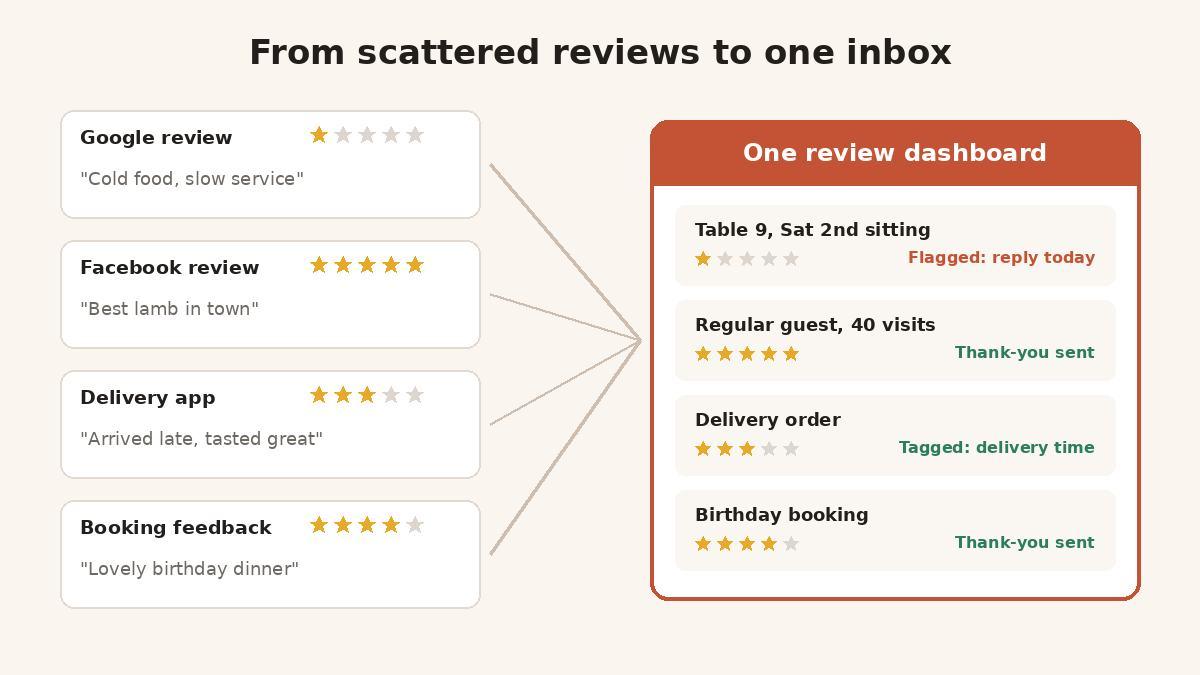
Reviews from several sites, gathered in one dashboard and linked to real guests
What good review management software actually does
Will software make the food better? No. What it does is clear away the admin, so the people who care can spend their ten spare minutes on the reply instead of on finding the review. Here is what that looks like in Eat App's version.
Bringing everything into one place
Google and Facebook reviews turn up in one feed. No more flicking between apps on a greasy phone by the pass. You can search for a word like "cold" or "rude," filter to one-star reviews only, or look at a single platform. There is a time-stamped log too, so you can see when something came in and how long it sat there before anyone answered.
Linking reviews to real guests
This is the bit restaurants should care about most. Eat App also runs bookings and tables, so a review can be tied to the guest's profile, their booking and their past visits. Picture opening a complaint about a cold steak and seeing straight away that it was table nine, second sitting, the Saturday the grill chef called in sick. Suddenly it is not a mystery. It is a Saturday staffing problem.
Replying faster without sounding like a robot
For the easy ones, like a happy five-star note after a birthday dinner, there are templates and automation rules. The tricky ones can be flagged so the manager hears about them right away, not on Thursday. A response manager also keeps an eye on reply times and nudges people when something has been waiting too long, which on a mad week is half the battle.
Spotting patterns
Then there is the bigger picture. The tool uses AI to read the mood of reviews and sum them up, and its reports show average rating, how many reviews are coming in and how many get answered. You can tag feedback by service, by time of day, even by staff member. If every moan about waiting comes from Friday dinner, that tells you something a single review never could.
A simple weekly routine that works
The habit matters as much as the tool. This is roughly the routine that seems to stick in small and mid-sized places:
-
Look at new reviews every day. Ten minutes with a coffee before lunch is plenty.
-
Answer the bad ones within a day or two. Short and calm. Say thanks, name the actual problem, say what you are changing, and give them a way to talk to you directly.
-
Answer the good ones as well. Two lines will do, as long as you mention something real, like the lamb they raved about or the anniversary they came in for.
-
Talk about reviews for ten minutes each week. Head chef, floor manager, you. Look at the tags, pick one thing to sort out, and leave it at that.
-
Go back to regulars who had a bad night. Drop them a message, and make sure whoever seats them next time knows.
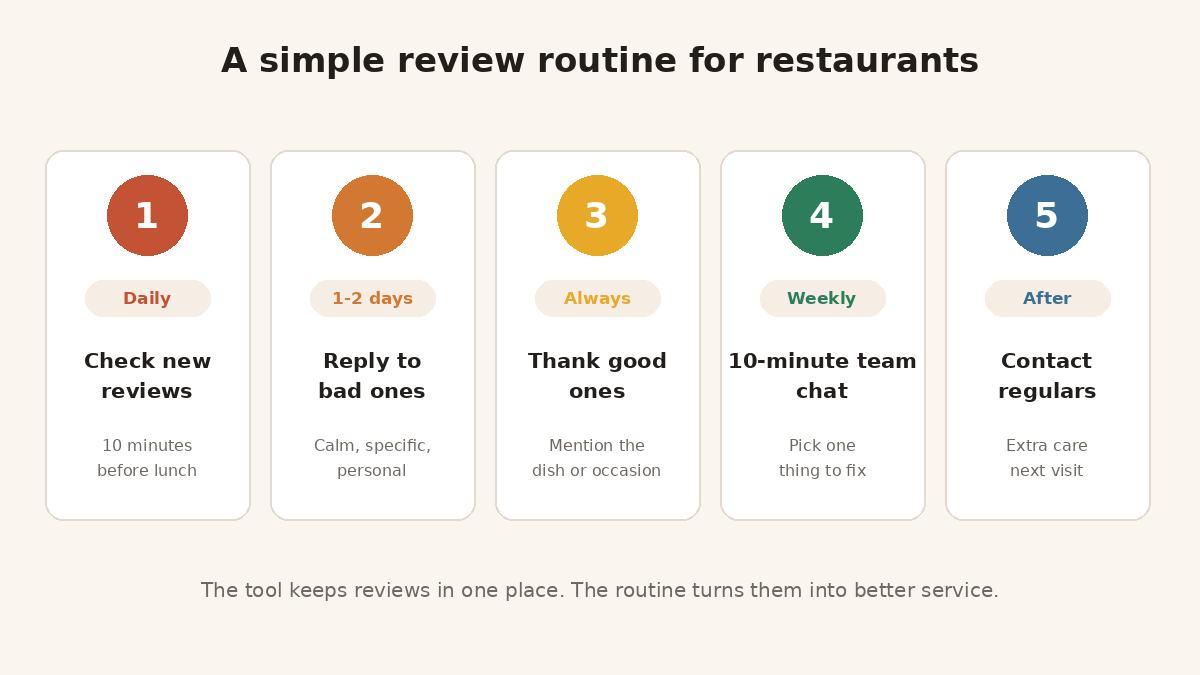
A five-step review routine any restaurant team can follow
What a good reply looks like
Something like this:
"Thank you for letting us know, and I am sorry your mains arrived cold on Saturday. That should not happen, and I have talked it through with the kitchen team. I would love the chance to make it right, so please get in touch and ask for me next time you book. Sara, owner."
It is personal, it admits the issue without grovelling, and it shows a real person is reading.
Common mistakes restaurants make with reviews
A good tool will not save you from a few classic own goals:
-
Getting into a fight in public. Even if the guest is talking nonsense, a long defensive reply reads far worse to strangers than the complaint did.
-
The same reply every single time. "Thank you for your feedback, we hope to see you again soon," pasted under fifty reviews, tells people nobody is really reading. Use templates as a start, then add a real sentence.
-
Skipping the nice reviews. The happy ones tell you what to protect. If three people this month mentioned the same waiter by name, that is worth knowing.
Choosing the right tool for your restaurant
A tiny café getting three reviews a week can probably manage with a shared inbox and some discipline. A group with a few sites and reviews landing every day will feel the difference of a real system almost immediately. Worth asking:
-
Does it cover the sites your guests actually post on?
-
Can it link a review to the booking and the guest?
-
Will your floor staff use it, or will it scare them off?
-
Does the price make sense for how many places you run?
And if your bookings already go through a reservation platform, keeping reviews there too just makes sense, because all the guest details are already sitting in it.
Final thoughts
My friend still reads every single review, and the bad ones still sting a bit. What has changed is the three-day silence. Now she sees a review the same morning, works out who left it, and answers before the lunch crowd turns up. Her rating has inched up. The bigger shift, though, is in the kitchen, where a one-star review is now a thing to fix, not a personal insult.
Reviews will always be loud, public and sometimes a bit unfair. With a simple routine and the right software behind it, they become some of the most honest feedback a restaurant gets, and a steady way to turn first-time diners into regulars.