Integrating Voice Agent APIs Into Online Ordering Systems: Webhooks, Events, and Sync
· 8 min read
Online ordering has shifted from a nice extra into the main traffic lane for many restaurants. The National Restaurant Association’s 2025 report, covered by Food & Wine, says takeout now accounts for 75% of restaurant traffic. That same report highlights how much customers care about speed.
Now add voice on top. A customer speaks an order while driving, walking, wrangling kids, guarding a skateboard, and thinking about fries. They will not wait while your system debates whether the coupon applies.
Here is the unpopular opinion: a voice agent integration that relies on direct, synchronous calls from the voice layer into your ordering database is a reliability trap. Many teams do this because it feels simple. It also creates fragile coupling, slow retries, hard-to-debug failures, and duplicate orders when a network hiccup hits.
An event-first approach is the better default. Webhooks and events become the “truth trail” that every system can replay. Sync becomes a controlled process, not a mysterious background vibe.
The core building blocks: webhooks, events, and sync
Think of the whole system as a relay race. The baton is the order state.
- Webhooks : Webhooks push information outward. Your ordering platform posts an HTTP request to a voice service endpoint when something happens, such as an order being paid. They are great for near-real-time updates, and terrible as the only source of truth.
- Events : Events are the ledger. They represent facts that happened in the system, stored in an event log, queue, bus, or database table designed for append-only history. When something breaks, events let you replay and rebuild the state.
- Sync : Sync is how you keep your voice agent’s view of the world aligned with the ordering system: menu items, modifiers, pricing rules, store hours, order status, loyalty points, and delivery windows. Sync fails in boring ways that cause very un-boring customer complaints.
A reference architecture that stays sane under pressure
Here is a practical flow that works for most online ordering setups:
-
The ordering system is the source of truth. It owns order creation, payment state, fulfillment state, refunds, and cancellations.
-
Voice layer is a client with memory. It keeps a session state, yet it never “wins” conflicts against the ordering system.
-
An event stream sits between them. Both sides publish and consume events. Webhooks become one delivery channel for those events.
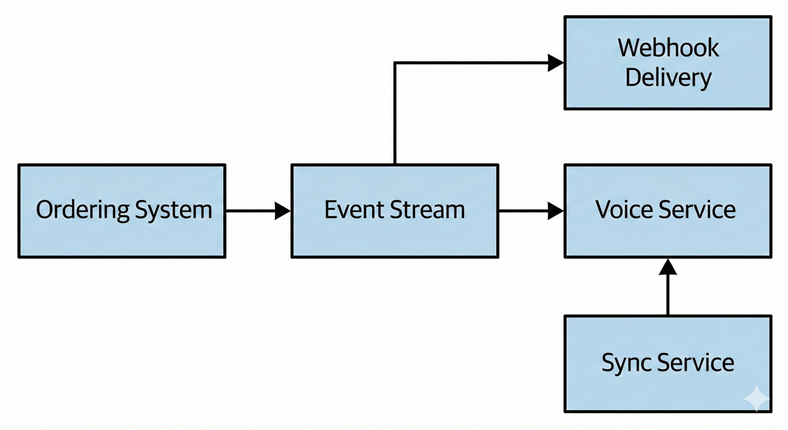
This architecture matches how real-world behavior looks. SoundHound’s research on US drivers found that many drivers want to place food orders through in-car voice assistants instead of waiting in a drive-thru line, and it frames voice commerce as a flow that includes ordering, payments, loyalty, and navigation.
Webhooks that do not betray you on Friday night
Webhooks fail. They fail when your endpoint is down. They fail when the sender retries and your code is not idempotent. They fail when a proxy times out. They fail when your signature check breaks after a minor config change. They fail when you deploy at the exact moment a customer says extra cheese, then your system hears extra chaos.
Design your webhook receiver with three goals: verify, dedupe, recover.
Here is a webhook consumer checklist that keeps you out of trouble:
-
Validate the signature and reject unsigned payloads, since spoofed order events are a real headache.
-
Store a unique event id, then treat repeated deliveries as normal, not as an emergency.
-
Acknowledge quickly with a 2xx response, then process asynchronously so timeouts do not trigger retry storms.
-
Record the raw payload for audit and replay, with safe redaction of card data, addresses, and phone numbers.
-
Use exponential backoff on your own downstream calls, then fail into a queue instead of blocking the webhook thread.
If you do only one thing, do the idempotency part. Duplicate fulfillment tickets cost money and trust.
Event design: what to emit, when to emit it, how to replay it
Events should represent facts, not guesses. They should be small enough to ship quickly, yet complete enough that downstream systems can act without scraping.
A good baseline set for online ordering voice flows:
- OrderCreated
- OrderUpdated
- PaymentAuthorized
- PaymentCaptured
- PaymentFailed
- FulfillmentAccepted
- FulfillmentInProgress
- ReadyForPickup
- OutForDelivery
- Completed
- Cancelled
- Refunded
Notice what is missing: “CustomerSoundedHappy”. Keep emotions for the conversation layer. Keep facts for the event layer.
For each event, include:
- event_id
- order_id
- store_id
- occurred_at timestamp
- version number for schema changes
- minimal payload needed to act, such as totals, items, modifiers, and status
Now the key part: replay. When you rebuild a voice session state, you should be able to consume events from a given timestamp, then reconstruct the order timeline. This replay capability is especially valuable when building AI agents that rely on historical context and event history to make consistent decisions and recover gracefully from service interruptions. That is how you fix outages without guessing what happened.
Sync traps: menu, pricing, stock, and order status
Sync is where good voice ordering projects get embarrassed.
Menu sync
If the voice agent offers an item that is not actually available, you get a broken promise. The customer hears yes, the kitchen hears no, and everyone hears yelling.
Treat menu sync as a timed job plus an event-driven update:
- scheduled full sync during low-traffic periods
- incremental updates when menu changes, sent as events
Pricing and modifiers
Pricing rules are often more complex than the menu itself: combos, size upgrades, limited-time promos, location-specific pricing, and tax rules.
The voice agent should not do “math by vibes.” It should request a priced quote from the ordering system when the cart changes, then speak the result.
Inventory and availability
Many restaurants update stock in the kitchen system, not in the online ordering system, and some keep stock entirely manual. That makes voice accuracy harder.
The practical stance: only promise what your source of truth can prove. If you cannot confirm inventory, phrase availability conservatively and offer the best available alternative in the menu catalog that is definitely sellable.
Order status sync
Status changes must move fast. If the customer asks, is my order ready, and you answer with incorrect answers, you lose customer trust.
Conversational AI in ecommerce has become an indispensable asset, offering low-latency voice responses that assist real-time order updates. Modern text-to-speech APIs now deliver fast first audio with multilingual support with more than 35 languages. For e-commerce optimization, if you're looking to enhance your online store's performance, partnering with a BigCommerce agency partner can help streamline integrations and ensure your systems work seamlessly.
Observability, testing, and rollout without drama
Voice integrations fail in two places: at peak traffic, and at the exact moment a customer is hungry.
Observability
Track these metrics:
- webhook delivery latency end-to-end
- event consumer lag
- duplicate event rate
- cart quote latency
- order submission success rate
- human handoff rate in the voice flow
A market that is growing fast tends to punish slow systems. Precedence Research estimates the online food delivery services market at $98.5B in 2025, with strong growth projections through 2034.
Testing
Test the integration with:
- recorded event streams replayed into a staging environment
- chaos tests that drop webhooks on purpose
- schema change tests that introduce new fields, then confirm older consumers keep working.
Rollout
Roll out by store, then by hour block, then by customer segment. Start with repeat customers who already know your menu, since they correct themselves faster. Teenagers will also correct themselves fast, though they will do it with extra confidence.
Conclusion
Integrating voice agent APIs into online ordering systems is not a single API call. It is a chain of webhooks, events, and sync decisions that must survive retries, partial failures, menu changes, and payment edge cases.
If you anchor the system on an event ledger, treat webhooks as delivery, and keep sync grounded in the ordering system’s truth, your voice agent becomes a reliable front door instead of a noisy experiment.
FAQs
Q1. What is the fastest way to start integrating voice into online ordering?
Start by exposing a priced cart quote endpoint and an order submission endpoint, then add event publishing for order status updates.
Q2. Why do webhooks alone cause problems in voice ordering?
Webhooks are delivery attempts, not a guaranteed history. An event ledger lets you replay what happened and recover cleanly.
Q3. How do I prevent duplicate orders when retries happen?
Use idempotency keys and store processed event ids. Treat repeated deliveries as normal behavior.
Q4. What should the voice agent cache locally?
Cache session context and recent menu data, then refresh pricing and availability through the ordering system before final confirmation.
Q5. How do I handle multiple languages without breaking the ordering logic?
Keep language in the presentation layer, keep ordering logic in events and APIs, then map spoken phrases into the same structured cart actions.